
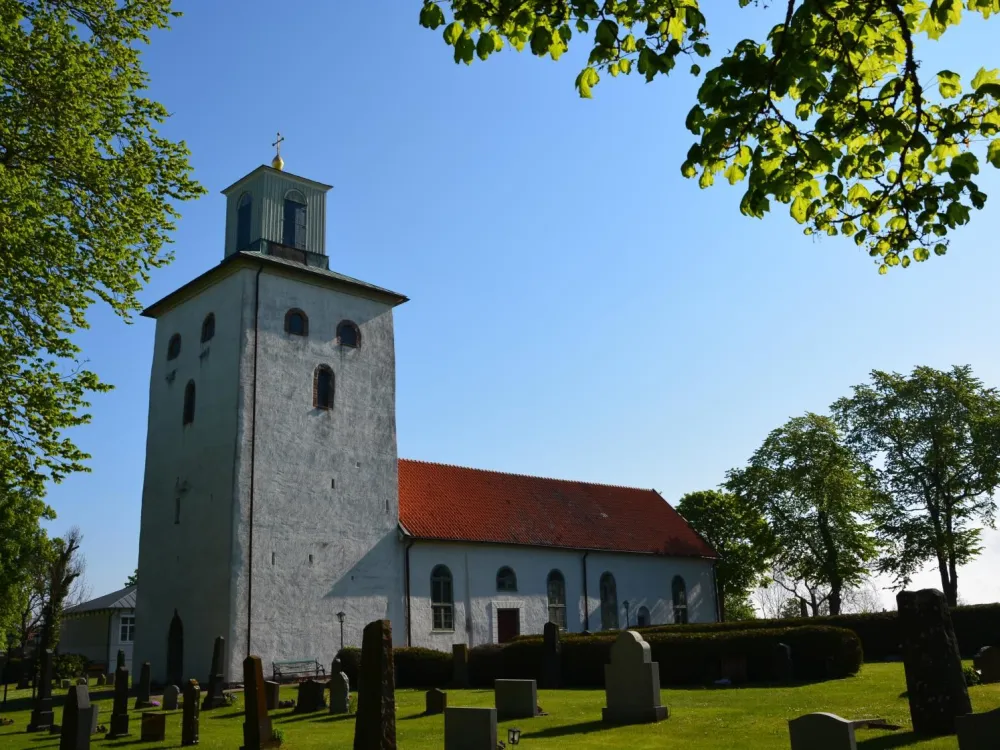
Vickleby Church
Vickleby church is located on the edge of the castle, just west of the western road.
From the cemetery you have a view of the barren Stora Alvaret in the east and the fertile valley with Vickleby village in the west. East of the cemetery is Vickleby village street with its dense buildings. There you will find i.a. Bo guesthouse and Capellagården. From the 1930s and 40s, Vickleby became a popular residence for many prominent artists. Several of them lived in the village, including Artur Percy. Directly below the church to the east is Vickleby vicarage, which still retains its original function. North of the cemetery is the former Vickleby church school, which is now an exhibition space attached to Capellagården. Even further north is the parish hall.
The Church
Vickleby church belongs to the small group of churches on Öland that have been completely or mostly preserved since the Middle Ages. The current tower was probably added to a wooden nave at the end of the 1100s. The stone nave was built in the 1200s. Under the leadership of the city masonry Anders Törnberg from Kalmar, the medieval chancel and apse were demolished in 1778-79, the nave was extended to the east and a new chancel was added. In 1818, the tower was given a four-sided lantern.
Memorial Grove
The memorial park is located outside the actual cemetery, in the north-east corner of the park-like area to the west. It is bounded by a semi-circular free-growing hedge of spirea, as well as a bed of pink-flowering shrub roses. The ground consists of a lawn and in the middle is a metal waterfall and an inscription plate. There is also a tall black-painted lighting fixture with glass globes
Buildings
There is no building in the cemetery, but on the other side of the road to the east. There is a building of limestone with a roof covered by an older single-domed brick, several of which have stamps from Värnanäs brickworks. It probably began construction in 1766 and was then called a "tool house". The outer walls were originally plastered, but are now bare masonry. In 1957, the southern part was furnished as a funeral chapel and the northern part as a tool shed.
Other
Older grave markers that had been removed from the cemetery leaned towards the western part of the northern wall.
In the building east of the main road there is a hemisphere of sandstone. This was on the baptismal font when it was the crest of the church between the years 1778 and 1932.