
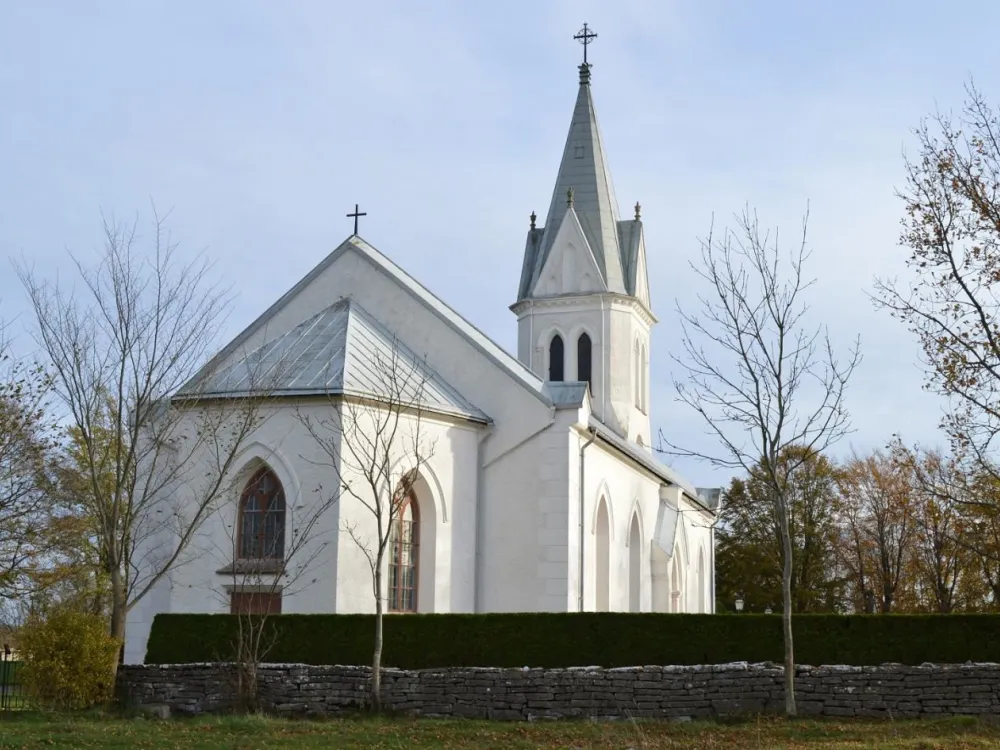
Source: church
Källa church and cemetery are located in the village of Vi along road 136 on northern Öland. Previously, the main road ran close to the church in the east, but today the road runs outside the village.
At the church there are some buildings gathered. There is still a shop here. North of the church, in Källaberg, is the new vicarage that was built in 1955. The old vicarage that was built in 1879 is located in the village of Högnäs. A few kilometers east of Källa church is Källa old church and cemetery, which was abandoned when the new church was completed in 1888.
The Church
Probably already in the second half of the 11th century, a wooden church was built in Källa parish. Traces of this have not yet been found, but are believed to be under Källa deserted church. During the 1100s and 1300s, building parts of stone were erected in various stages. The church in Källa, like so many other Öland churches at this time, became a defensive church. By the middle of the 13th century, the church building had taken on the shape it still has today. During the period 1500-1880s, when the new church was completed, several renovations and reconstructions were made. Several of the repairs were extensive. In 1855, it was found that the church was in poor condition and for the first time it was proposed that a new church should be built. Negotiations on the location of the new church began and in 1880 it was decided to buy an area in the village of Vi. The centre of the parish was thus moved a few kilometres east to a geographically more central location in the parish. The land of 1 1/2 acres was bought by Nils Persson and cost SEK 600. A drawing was prepared by the engineering firm Hultqvist and Ackzell, Mönsterås. This was worked on by Ludvig Peterson. Work began in 1886 and two years later it was completed. The building is characterized both inside and outside by neo-Gothic stylistic features. The chancel is located to the west and the tower to the east because the main road previously passed the church on this side.
Memorial Grove
The memorial grove was established in 1998 in the northeast corner of block C. The site is surrounded by a thuja hedge. In the center there is a large stone surrounded by two pieces of Öland cane. In front of the stone there is a flower bed for summer flowers and lighting in the style of old gas lanterns. In the memorial grove there is also a bench for visitors. Buildings West of the cemetery there is a building that houses staff rooms, garages, etc. The building has standing red-painted wood paneling, a black tin roof and white carpentry. Other In the northwest corner of the cemetery there is a parking area for grave markers that have been removed from the cemetery. The grave markers are mainly from the time around the turn of the century 1900 and there are cairns of both limestone and granite. They stand on a slab of cement. On the outside of the cemetery wall to the east, there are limestone horse ties attached to the wall.
Source: Kalmar County Museum