
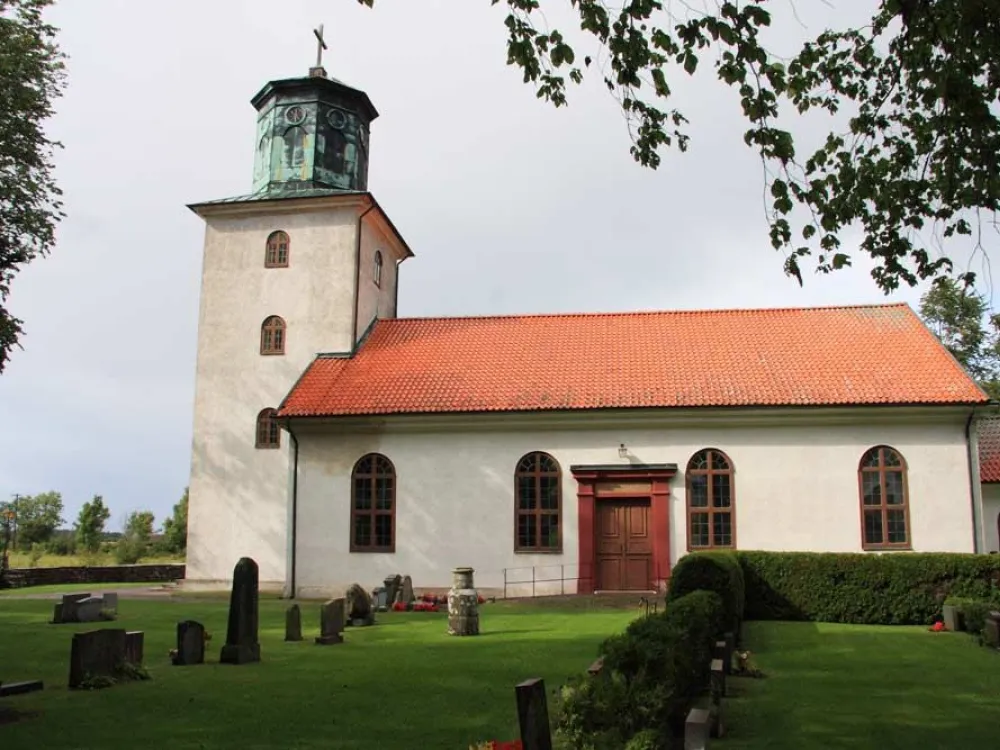
Segerstad Church
Segerstad's church and cemetery is located on the east coast of southern Öland, next to the eastern highway in the southern part of Nedra Segerstad village.
Around it, arable, pasture and alvar land spreads out. South of the cemetery is the former vicarage. Just north of the cemetery next to the main road is the old wooden school, built in 1848.
The Church
Segerstad's medieval church was the smallest on Öland, only 16 meters long. The foundation walls of the small east tower church with a straight east wall built in the 1100s are under the floor of today's church. A pillar of finely hewn Gotland limestone supported its arch. The pillar's chapter is now under the baptismal font while other parts can be found in the plinth of the sun hand out in the churchyard.
The present church is a traditional hall church with large round-arched windows and wooden barrel vaults. The tower to the west is crowned by an octagonal lantern. The sacristy is located to the east.
The church was built in 1839 by Peter Isberg according to drawings by R V Brouhn. After the consecration in October 1843, apart from an exterior restoration in 1949-51, only minor changes have been made.
The 19th century church was equipped with an altar pulpit. The basket sculpted in 1765 by Clas Wahlberg was taken from the old church. When the church was renovated in 1949, the pulpit was moved to the north side of the chancel and inside the altar ring a new altar was placed.
Some of the inventory is left from the 1100s. The altarpiece was painted by Einar Forseth, in 1950, and there is a painting with Öland's motif painted by the "sun painter" Per Ekström inside the church.
Buildings
In the northwest corner of the cemetery is an old whitewashed stone building with a tiled roof. Previously it was used as a mortuary, now only as a storeroom.
Outside the cemetery wall to the south is a smaller wooden building that is used as a storage room and where there is also a toilet for the public.
Other
At the entrance to the cemetery to the west is a limestone slab with the inscription: "Wandringsman think of the end 1776.s.s. Pastor" It was erected by the then pastor Sven Sahlsten. Sahlsten wanted to give the walker a reminder of his mortality through the carving on the slab and thus bring the idea of piety to life.
A sun hand stands in the churchyard south of the church. It is partly built of capitals from the old church. When it was made is unknown.
In the northeast corner of the cemetery, set up along the wall, are cairns that have been taken out of use.
The artist Per Ekström was born in Segerstad and died at Sjöbacken in Mörbylånga in 1935, at the age of 91. He became widely known and was rewarded, for example, with a gold medal at the World Exhibition in Paris in 1889. He went down to literary history as the painter Selldén in August Strindberg's "The Red Room". He is also said to have been the one who got Strindberg to start painting.
The wood artist Johan August Gustafsson (1852-1932) lived his entire life in Segerstad parish on southeastern Öland. He was a farmer and sailor, but above all he was an artist, sculptor and cabinetmaker. Materials that he found in the lake and on the beach he used to sculpt in. The sea and boats were an important part of his life. He made many ship paintings and ship models. The farm that he farmed was right next to the Baltic Sea, which inspired him and provided material for the artworks. When ships were shipwrecked, he received wood for his figures. His most famous sculpture is "King Pharaoh with Entourage". Two carved chairs, from 1916, are in front of the chancel of the church. As his last will, he wrote in his will that the collection should be displayed and cared for in his home area for a small fee.