
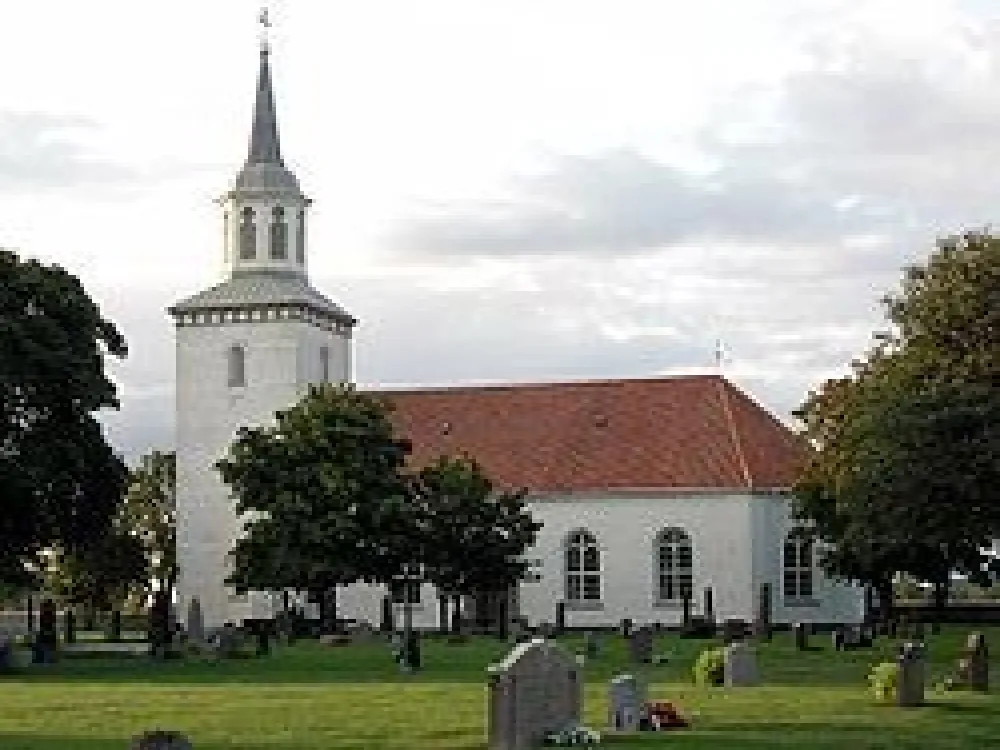
Sandby Church
Construction began in Sandby stone church in the 1100s. At that time, naves and towers were erected to the east.
During the 1200s, the west tower was added, which made Sandby church one of Öland's cloven-hoofed saddle churches. In 1782, a major renovation of the medieval church was carried out, which included the demolition of the east tower.
In the early 1800s, the proposal was raised to build a joint church for Gårdby and Sandby parishes. However, the proposal did not gain traction, and both parishes instead rebuilt their medieval churches.
In Sandby, work began in 1860. The drawings for the new church were made by J F Åbom and the builders were Peter Isberg and his son Isak from Algutsrum. The new church was built south of the medieval church. The baptismal font from the 1100-1200s was transferred to the new church. The new church is characterized both internally and externally by neoclassical features.
The last major renovation was carried out in 1992.
Memorial Grove
The memorial grove was established in 1999 west of block B. The site is surrounded to the south and to the north by hedges of thuja. In the northern part there is a simple wooden cross. In front of it there are flower beds, an area paved with limestone where you can place candles and a holder for flower vases. To the south there is a bench.
Other
East of the church's chancel is the Patriarchal Cross, which was found in 1957. The cross is marked with edged limestone splinters that are slightly raised above the grass. No one knows the history of the cross today.
In the south-east corner of the cemetery is a small hill. This is where the temporary smithy that was built in connection with the church building in 1860 is said to have been located. The blacksmith August Klinth worked here, among others. He and several other family members are buried in the Klinth hill in the southwest corner of the cemetery.
South of block B is a basin made of limestone and a birdbath of the same material. In the northeast corner of block B there is a sun hand on a bricked pillar of limestone.
Source: Kalmar County Museum