
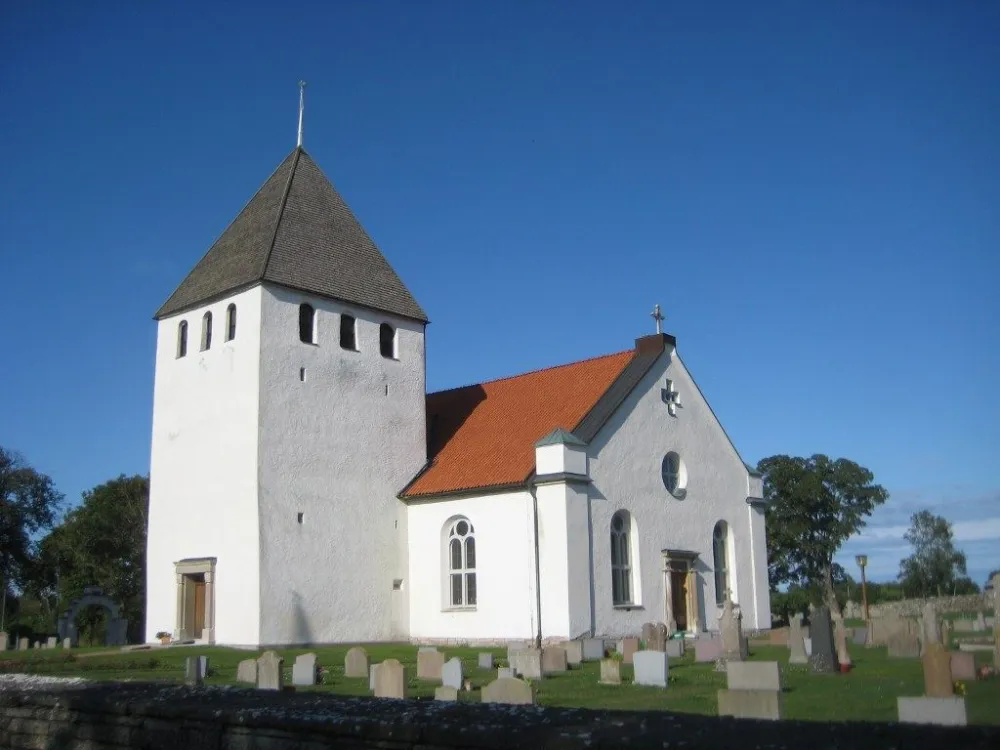
Persnäs Church
Persnäs parish is located on northern Öland between the parishes of Föra and Källa. The church village is located a few kilometers east of road 136. The church is surrounded by agricultural land, but the parish's main industry has long been quarrying.
West and south of the church are remains of old quarries. The stonemasonry traditions are also evident in the many barns of limestone, remains of scouring mills, etc. Even today, stone is quarried in the western parts of the parish.
Probably already in the first half of the 12th century, a nave and a narrow chancel were built in stone. The west tower and the east tower were probably added shortly after each other during the late 12th and early 13th centuries. The cross arms of the church were built in the middle of the 13th century. The porch in the south and a material shed in the north were probably added shortly afterwards. During the end of the Middle Ages, several changes were made to the interior of the church. The sacristy was added in 1650-62 at the angle between the east tower and the north cross arm. Throughout the 17th and 18th centuries, the parish had considerable expenses for the maintenance of the church. Some costly changes were also made.
An organ was installed inside and a gallery was built in 1756-59. In the mid-1800s, the church was considered so old that money began to be collected to build a new one. The old church had also become cramped as the population of the parish grew during the 1800s. Drawings were drawn up and sent to the superintendent's office. The matter was handled by the architect C G Blom-Carlsson, who instead recommended a rebuilding of the old church and made a new proposal. According to the proposal, the cross arms were to be expanded. Work on the new cross arms began in 1856. The following year, when the old cross arms had begun to be demolished, the east tower collapsed. Rebuilding the tower would be too costly and the congregation was instead given permission to build a new chancel in the east. Originally, the sacristy was housed in the eastern cross arm behind the altar, but it was moved in 1959 to the northern cross arm.
Buildings
In life with the cemetery's wall to the west is the mortuary. When the building was originally erected is not known. Until 1966, when the building was renovated, it was used as a storage room and a temporary mortuary. During the renovation, a funeral room and better storage were prepared. It is still used today as a storage room but also as a mortuary. The façade is alcohol plastered with smooth extents and decoloured in white. The roof is covered with brick and carpentry painted black. Outside the northwest corner of the cemetery is a newly built caretaker with staff quarters and a garage. The building has standing grey-painted wood panelling, white carpentry and a black tin roof.
Other
Until 1848, several old grave slabs were located in the cemetery. Many were used for the new church's floor in 1857. One of the most talked about slabs is Sigmund from Horn's grave slab from 1341. Another famous grave slab is Digerflisan, which lies as a stepstone at the church's southern entrance. According to legend, there were no more survivors of the Black Death in the 1300s in Persnäs parish than they could fit at Digerflisan. South of the mortuary there are several older grave markers set up along the entire southern part of the cemetery wall. There are, among other things, several old limestone crosses and some cast iron crosses.