
Horn's royal estate
A village with medieval ancestry that was established as a king's barn by Gustav Vasa. Ruin from the 1500s and restored archaic arable, meadow and pasture landscape. The king's estate is still in state ownership.
During the latter part of the Middle Ages, Horn was a village consisting of six farms. All the farms were owned by the farmers themselves. Horn's royal estate was established in 1551 when Gustav Vasa evicted the six tax farmers in the village and merged the farms into one royal estate. The farm was henceforth managed by a bailiff who had an accountability to the king. One of the tasks of the royal estates was to deliver goods that the king needed, and in the mid-1550s, Gustav Vasa ordered that the lime found at Horn should be sent to Kalmar where it was needed better. At the same time, the king wrote to his fatabur's wife Anna in Stockholm that she should find out the skins and cheeses that had come from Horn and Borgholm's barns when she had checked the weight. Through written source material, we know that Gustav Vasa, like his son Erik XIV, visited the estate for short periods of time. Over time, the farm was leased and the farm's chores were taken care of through the day's work by the people who lived on the up to 18 crofts that were under Horn. In the 1900s, there was also a certain statarinstitution. Today, some of these crofts still exist, but as holiday homes.
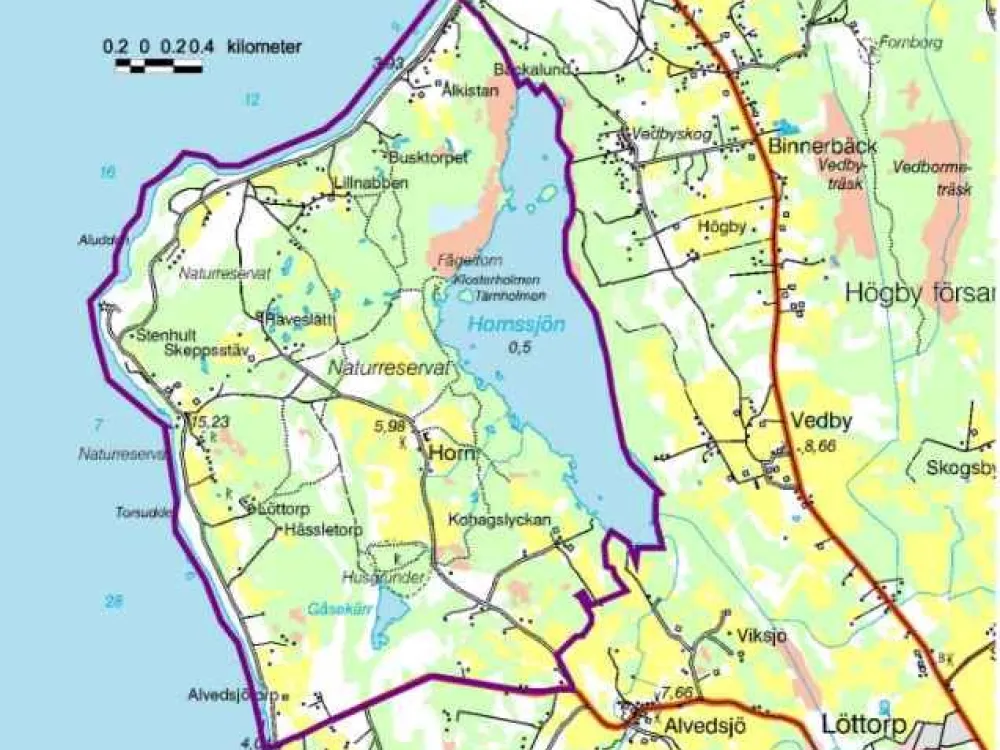
Horn's first farm facility is not known in appearance, but there are many indications that it was located in the same place as today. The main building consists of a large hall building under a broken roof. Through a fire in 1941, most of the farm buildings were destroyed, but many were built on the same site. Among the industries that have occurred can be mentioned beekeeping in the 1500s. In the 1800s, there was a distillery down by Hornsjön. Fishing in Hornsjön has been a significant contribution to the farm's economy, including significant eel fishing. Hornsjön is today Öland's only lake and leaves a great mark on the area. The lake's lowering was completed in 1910 and then comprised 1.3 meters. It can be noted that the water mirror was part of the Baltic Sea until about 700-800 AD and until then it has been a protected sea bay. At the western edge of the lake is the legendary Klosterholmen. As the name suggests, the stone ruins that are here have long been associated with monastery activities, which today can be dismissed. Instead, it is a so-called permanent house, i.e. a medieval large farm with a defence function, a private castle. There are also other ancient remains at Hornsjön. South of the farm there are, among other things, the remains of four Iron Age farms with associated stone string systems. In addition to additional house foundation areas, there are also graves and an area with fossil fields next to Hornsmosse.
Horn's first farm facility is not known in appearance, but there are many indications that it was located in the same place as today. The main building consists of a large hall building under a broken roof. Through a fire in 1941, most of the farm buildings were destroyed, but many were built on the same site. Among the industries that have occurred can be mentioned beekeeping in the 1500s. In the 1800s, there was a distillery down by Hornsjön. Fishing in Hornsjön has been a significant contribution to the farm's economy, including significant eel fishing. Hornsjön is today Öland's only lake and leaves a great mark on the area. The lake's lowering was completed in 1910 and then comprised 1.3 meters. It can be noted that the water mirror was part of the Baltic Sea until about 700-800 AD and until then it has been a protected sea bay. At the western edge of the lake is the legendary Klosterholmen. As the name suggests, the stone ruins that are here have long been associated with monastery activities, which today can be dismissed. Instead, it is a so-called permanent house, i.e. a medieval large farm with a defence function, a private castle. There are also other ancient remains at Hornsjön. South of the farm there are, among other things, the remains of four Iron Age farms with associated stone string systems. In addition to additional house foundation areas, there are also graves and an area with fossil fields next to Hornsmosse.