
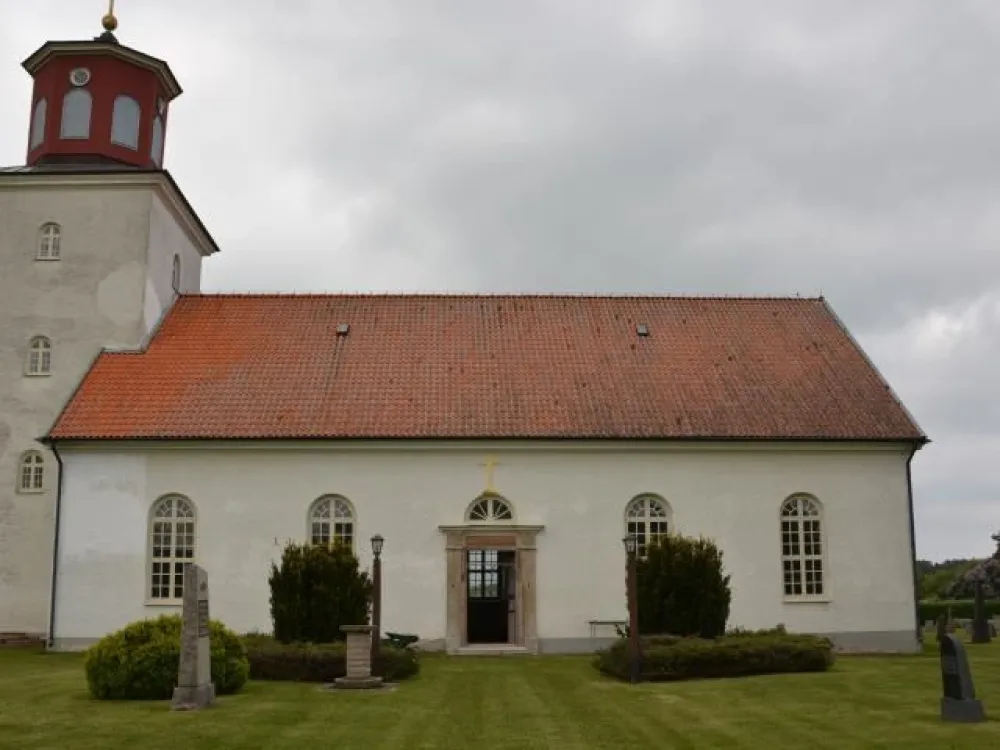
Gårdby Church
Gårdby church and cemetery is located where the road, which runs along the east side of Öland from Föra in the north to Ottenby in the south, meets one of the roads to Törnbotten and Färjestaden.
Closed due to renovation in 2017.
A small community with residential buildings has grown up here. The community used to have service functions such as a general store, railway station, telegraph station and smaller workshops. Today, most of this is gone, but the school still remains.
In Gårdby is also Eksgården with a restaurant and conference facility. East of the church is the parish hall.
The Church
When Gårdby's first stone church was built is not known, but in the 13th century there was a church building in Romanesque style. The church had a nave, chancel and apse. The tower is said to have been one of the most powerful on Öland with a base measurement of 9×10 meters.
In the early 1800s, a proposal was made to build a joint church for Gårdby and Sandby parishes. However, nothing came of this. Instead, the two parishes each built a new church.
In Gårdby, the new church was completed in 1841. At that time, the walls from the medieval church had been partly used. The architects were T Edberg and N I Löfgren and the builder Peter Isberg from Algutsrum.
Both inside and outside, the church is characterized by classicist stylistic features. The church has been renovated on several occasions. The last time was in 1989.
Memorial Grove
The memorial grove is located in the southern part of area A. It is open to the north and is shielded to the south by a thuja hedge, planted in an arch. Along the hedge there is a bench.
The memorial grove is marked by a wooden cross. Around this there is a flowerbed with a border of limestone around it. In the flowerbed grow insects and roses, among other things. There is also a stand for vases. At both ends of the thuja hedge there are stone birdbaths.
Buildings
East of the cemetery is a building that houses storage and a workshop. It has white-painted concrete walls, except in the gable end, which has red-painted upright board paneling. The roof is covered with red brick and the carpentry is painted white.
Other
Grave markers that have been removed from the cemetery are placed along the cemetery wall to the south. A smaller collection also stands along the wall south of the entrance to the east.