
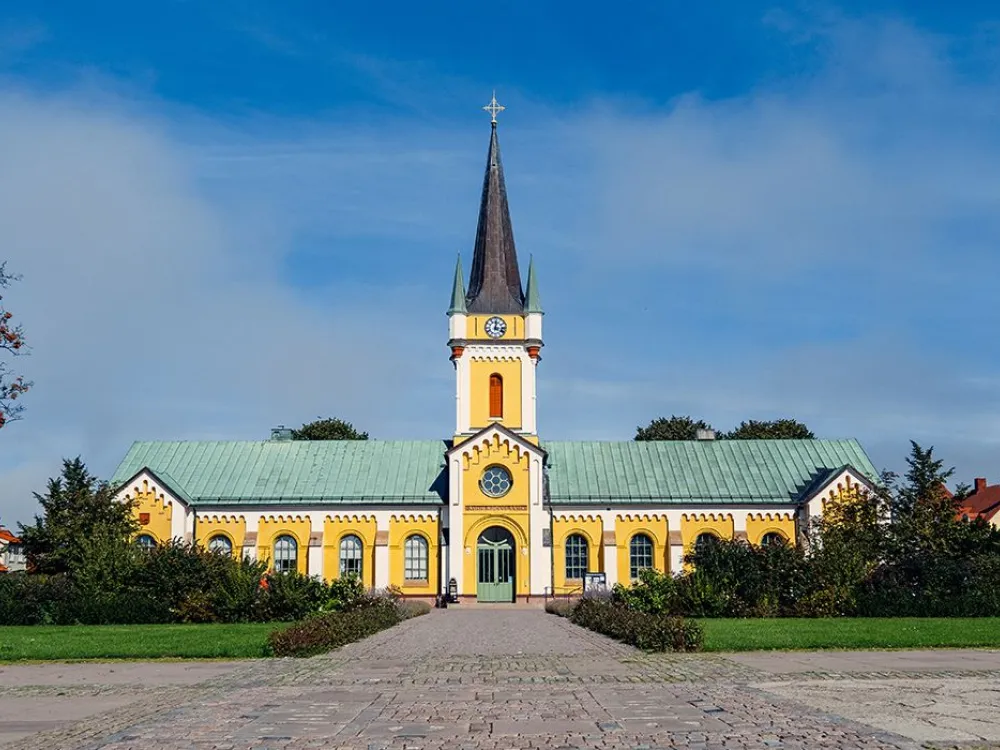
Borgholm Church
Borgholm Cemetery is located in the northwestern part of the city. The site is surrounded to the north by a strip of beach facing Kalmarsund, to the east by Kapelluddens camping, to the south by Sandgatan and Bäckmans park, and to the west by the harbour area.
What was once the outskirts of the city has now become part of the urban environment. The church is located some distance from the cemetery at the square. This type of solution with church and cemetery some distance apart became common in the cities during the 1800s.
The Church
Construction of the church in Borgholm began in 1872. Previously, the schoolhouse had been used as a church premises. When a church was built, it was built together with a new school building. The architect was Ernst Abraham Jacobsson, Stockholm, and the builder was Chronwall, Kalmar. The part that housed the school was completed as early as 1873, while the construction of the church was delayed due to a lack of money. In 1879, the church was consecrated by Bishop Pehr Sjöbring, Kalmar. The style is neo-Romanesque with buttresses, round-arched friezes, blinds and the tourels of the tower. The tower is placed in the middle of the building body and the chancel faces east. The exterior has not undergone any major changes. The interior of the church was originally decorated in a typical neoclassical style. The church was renovated in 1935, but it was given its current appearance during a rebuilding in 1960-61. The new interior was designed by architect Carl Hampus Bergman. In connection with the reconstruction, the former school building became a parish hall. This part of the building had been used for several different activities during the 1900s.
Memorial Grove
The memorial grove was established in 1985 and is located at the northern wall of the cemetery between the area from the 1920s and St. Elavi chapel. The area has the shape of a triangle and is surrounded to the east, west and north by a limestone wall. Inside the wall, ornamental shrubs are planted to the west. At the entrance, two stunted elms grow. Into the memorial grove leads a path paved with limestone splinters. In the northern part there is a pond and around this there is space to place flower vases. North of the pond grow two blue spruces, ornamental shrubs and summer flowers. Between the two blue spruces stands a cross of wood. West of the pond there is a cabinet in black-painted sheet metal where grave candles can be placed. In the eastern part of the area there is a stone with an inscription in gold. Several pine trees grow in the area.
Buildings
In the northeast corner of the cemetery is St. Elavi Chapel. The building, inaugurated in 1971, is built of yellow brick with a flat roof covered with green sheeting. The interior of the walls is also clad in yellow brick. The chapel's altarpiece consists of large windows with a beautiful view of Kalmar Sound. The building also houses a mortuary that serves the whole of northern Öland.
The janitor's office
South of the part of the cemetery that was added in the 1950s is the caretaker's office. There are two buildings here. Both are clad with upright green-painted wood panelling and have roofs covered with red-painted sheet metal. They house staff rooms, storage rooms and garages. There is also a simple canopy, composters and storage areas.
The old janitor's office
At the angle between the old cemetery and the part that was added in the 1950s is the old caretaker's office, which is now used as a storage room. The building has a flat roof and brown-painted standing wood panelling.
Other
East of the part of the cemetery that was established in the 1990s is a cemetery park with plantings of shrubs and trees as well as lawns. In the northern part of this area there is a ceremony site marked by a wooden sculpture. Next to the ceremony site is an area covered with limestone splinters. There is a pond and benches.
There is no orderly place for grave markers that have been removed from the cemetery. Instead, these are gathered in connection with the caretaker's office.
In the south-eastern corner of the old part of the cemetery, there are still traces of St. Elavi Chapel that originally stood on the site. The traces consist of a slightly elevated rectangular area. According to reports, building remains are found here in connection with the re-excavation of graves.
Source: Kalmar County Museum